Where does Count fit in your stack?
Written by The Count Team

Count bridges data and business teams, enhancing collaboration and decision-making in the Modern Data Stack and beyond. Ideal for BI and collaborative analytics.
When people describe Count, they typically do so in terms of familiar functionality:

While those descriptions are helpful (and entertaining) they are less effective in articulating what you actuallydowith this feature mash-up, and how it works in combination with other tools in your data stack.
Count and the Modern Data Stack
The Modern Data Stack (MDS) is the suite of tools and functionalities seen as essential to modern data teams. The MDS is represented as a diagram showing data sources (e.g. payments) traveling through your data pipeline, and eventually terminating at a final dashboard or report (e.g. a company's KPI dashboard).
These diagrams have come to dominate our LinkedIn feeds, data Slack channels, and product websites as they effectively show all the data tools in our environment, and how they relate to one another.
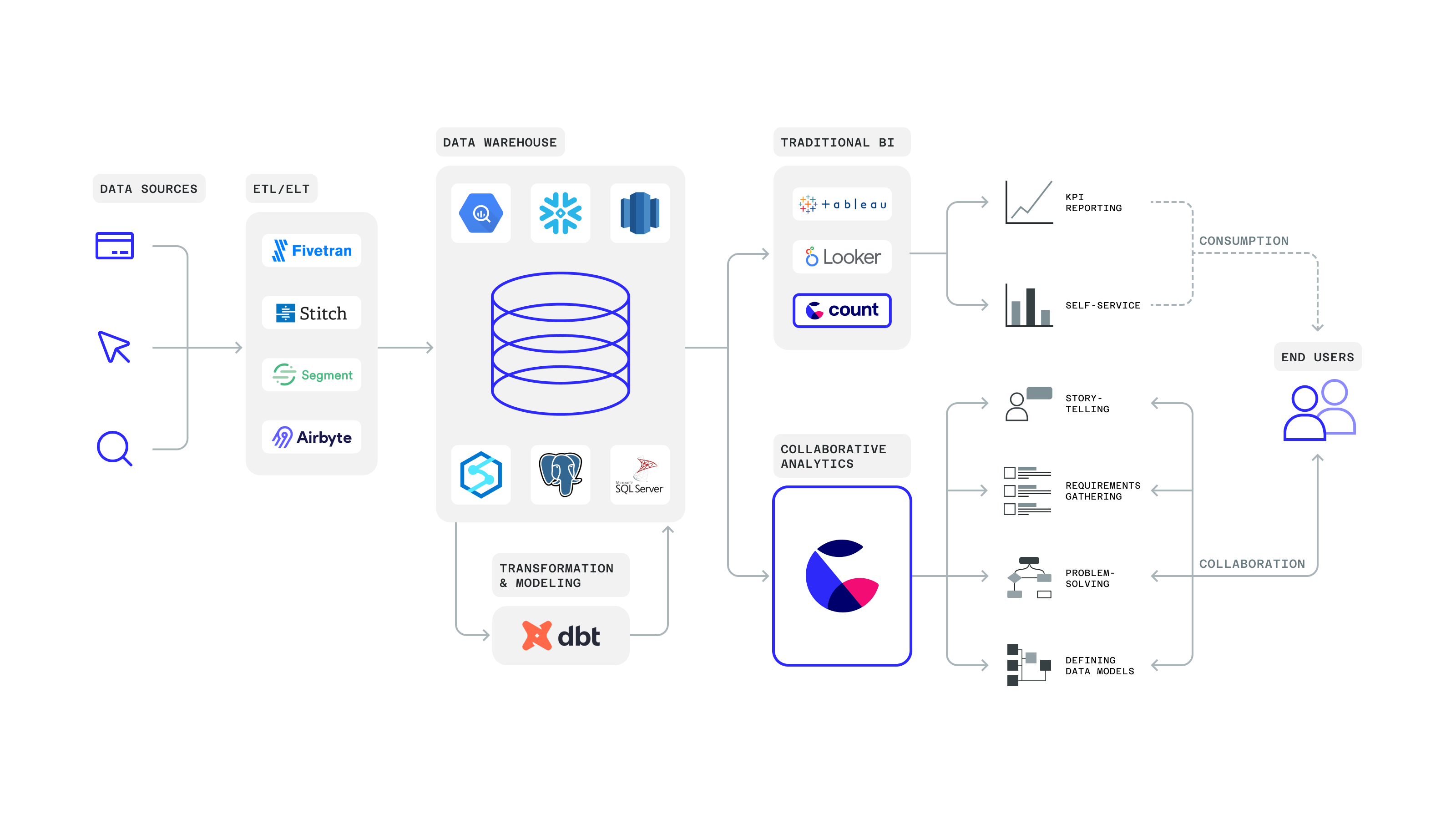
To put Count in the context of the Modern Data Stack, we can understand three key points:
1. Count runs on your database or data warehouse
Count does not store or alter your data, but rather sits on top of your data warehouse. Queries written in Count are sent to your data warehouse, and results are returned and presented in Count.
You can learn more about querying in Count.
2. Count can do old-school BI
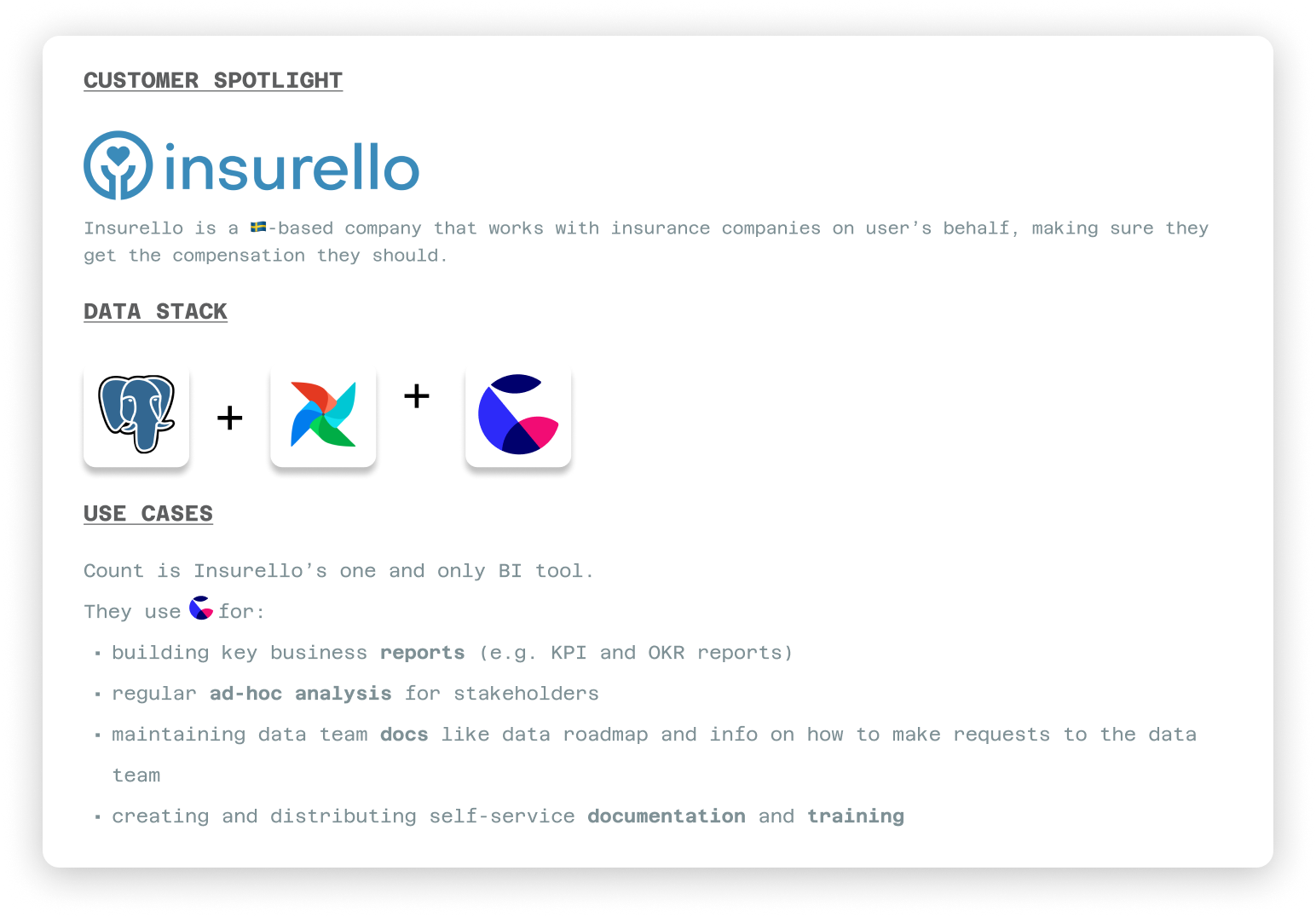
If you don’t have a traditional BI tool, you can create reports, dashboards, or even presentations in Count.
TakeInsurellofor example:
3. But it’s built for more
If youdohave a traditional BI tool, then you can of course use that tool to do your traditional reporting to the business.
But there are many pieces of work today that we do in BI tools that simply don't work like:
- quick ad-hoc requests turned into a dashboard and then never looked at again
- trying to communicate complex problems (like user journeys) in a grid of charts
There are even more business-critical activities that we do elsewhere like:
- requirements gathering
- getting feedback
- documentation and explanation
- mapping out a new data model
These activities fall under the realm ofCollaborative Analytics: a set of tools dedicated to bringing our insights closer to the business decisions they inform.
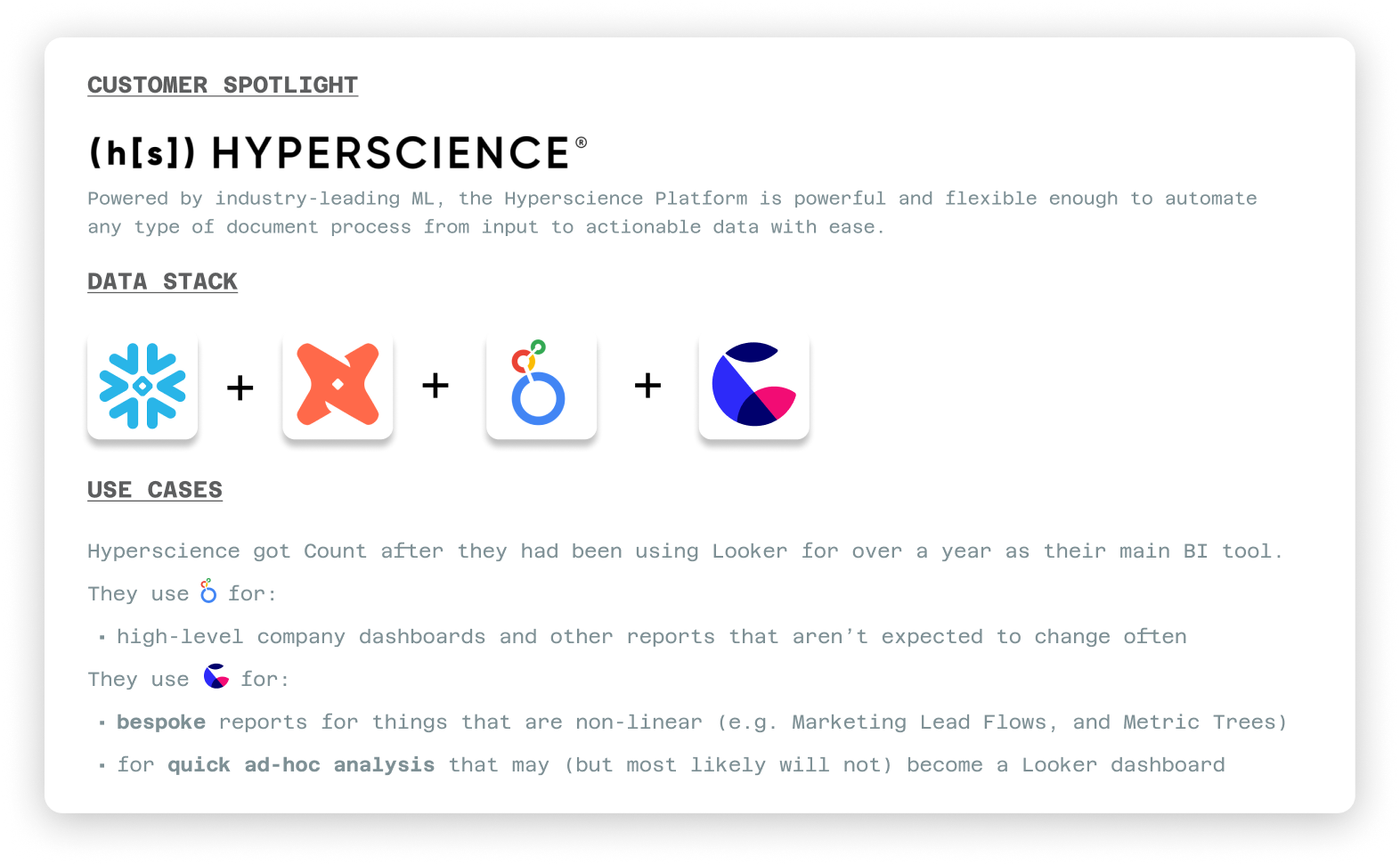
So if you have a traditional BI tool, you can keep using it for your traditional reporting, but when you need a more collaborative approach, use Count. TakeHyperscience, for example:
To the end of the stack and beyond
Believe it or not, there exists a world beyond the reaches of the Modern Data Stack. A world where the insights produced by the MDS make their way into the business and (hopefully) inspire strategic decisions, inform experiments, and spark creativity. This space is known asThe Last Mile of Analytics.
"The last mile of analytics refers to the space between the data team and the business teams; it is the moment between someone looking at your report or dashboard, and thethey take as a result; it encompasses all the back and forthwe get about ‘what this graph means’ or ‘what data is included there’; it’s where wethe problems of our stakeholders, and how we can help solve them." -
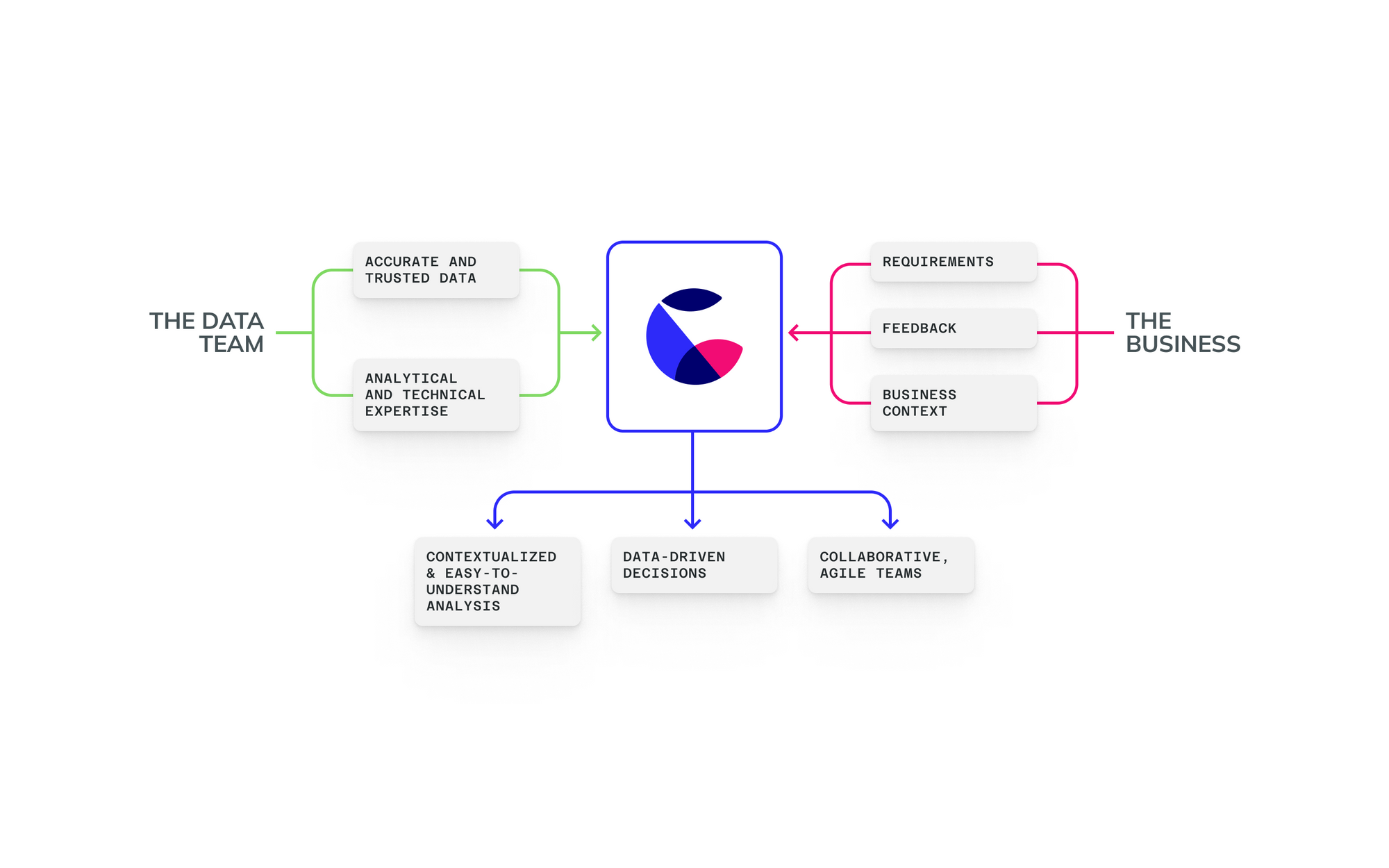
By zooming out of the MDS we can see our data pipeline in the context of the business problems it influences, and the great lengths it has to get there. Both the data and business teams have to traverse this space in order to deliver the ultimate and illusive outcome: business impact.
The crucial differences between Count in the context of the MDS vs The Last Mile are:
- data and business users are seen as equal contributors and users of the tool and must be able to communicate in a shared context
- business problems take precedence over data models
- teams iterate quickly and often to arrive at solutions rather than doing long cycles of waterfall development
- transparency builds trust so all analysis is made to be understood by others
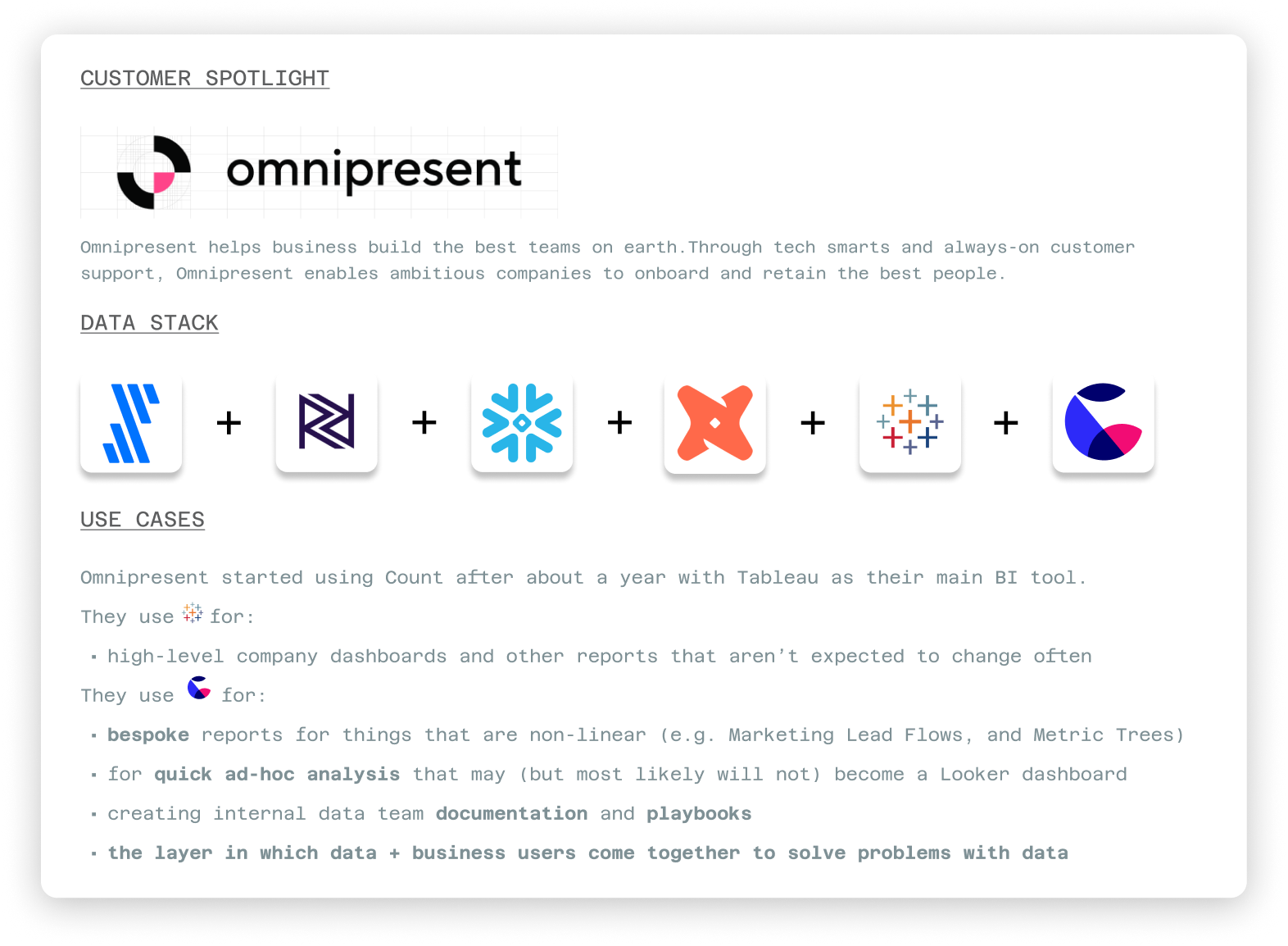
Omnipresent, who has quite a mature data stack, is currently using Count to address their Last Mile challenges:
In summary
Perhaps that was a more long-winded response than you were expecting from such a simple question, but we are nothing if not thorough. In the end, Count is a tool designed to bring your data and business teams together to solve problems and make better decisions. How you use that capability can fluctuate depending on what you need most, and what other tools you have at your disposal.