It’s not about AI: Announcing Count’s AI Strategy
Written by The Count Team
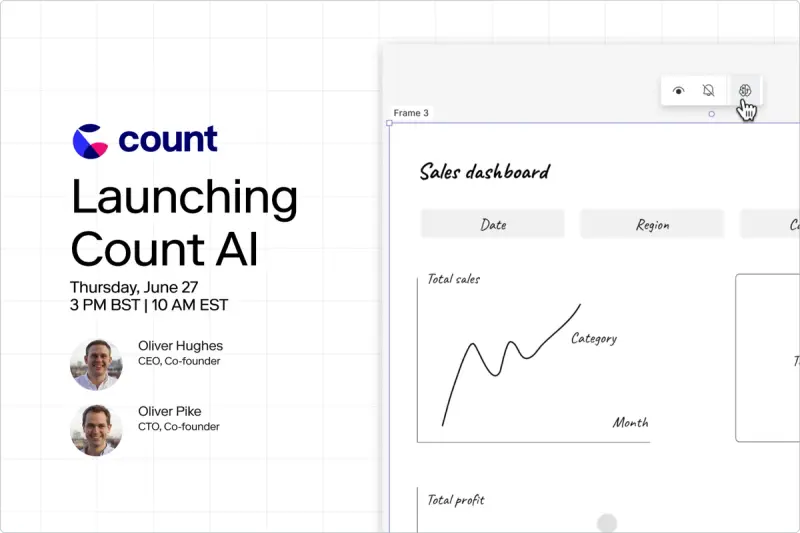
Discover Count AI: Seamlessly integrated AI for dynamic data workflows, enhancing flexibility, collaboration, and transparency. Join our live launch event on June 27th!
[Direct video Video: https://storage.googleapis.com/count-static/site/videos/Count%20AI%20(HD).mp4]
I’ve often joked with the team that we were probably the only technology company not to have AI in our product. While that’s a bit of an exaggeration, it’s fair to say we’ve taken our sweet time.
Today I wanted to break our silence on AI, explain how AI fits into Count, and how we think it impacts the future of data.
Why it took so long
The main reason we’re late to the AI party is simple - we wanted to do it properly. Great products don’t get built by wedging new technologies into existing experiences. Instead of following the market and adding AI to tick a box, it was important for us to know how and why our product would be better with AI while staying true to our core values offlexibility,collaboration, andtransparency.
We’ve also been waiting for the right model. While LLMs have been the dominant driver behind most AI features, the canvas has always been more dynamic than just code, text boxes, or chat bots. Our users work with large compositions of cells, DAGs, sticky notes, prototypes, and productionalised models and reports side by side. To create an experience of that kind of complexity, we were going to need something else.
In the last few months, multimodel models have significantly improved, opening the door for us to create an AI experience that was worth the wait.
Count AI: A preview
After months of tinkering, we are putting the finishing touches on the Beta version of Count AI.
As dynamic as the canvas
The first thing to say is this isn’t just any SQL-generating LLM model - Count AI is seamlessly integrated into every aspect of the Count canvas. Whether you're scoping out a project with sticky notes or screenshots, doing some data cleaning in Python or SQL, or trying to build a beautiful presentation, Count AI is there and can see it all, helping you automate tasks across every step of the analytical workflow.
.video-container {
position: relative;
width: 100%;
overflow: hidden; /* Keeps everything neatly contained */
}
.video-container video {
width: 100%; /* Ensures the video fills the width of its container */
height: auto; /* Height will be set by JavaScript to maintain aspect ratio */
position: absolute;
top: 0;
left: 0;
}
.caption {
text-align: center;
margin-top: 5px; /* Adjust this value based on your preference */
font-size: 18px; /* Adjust font size as needed */
}
Your browser does not support the video tag.
Prototype of Count AI.
function setVideoContainerHeight(video) {
const container = video.parentNode;
const height = video.videoHeight * (container.offsetWidth / video.videoWidth);
container.style.height = height + 'px'; // Adjust the container's height based on the video's aspect ratio
}
Transparent, always
Count is, and will always be, against black boxes and ‘magic answers’. Transparency is required to facilitate trust, and that trust is foundational to a data team’s success.
Every visual, chart, and DAG that’s created is available as SQL or Python code so you know exactly what’s happening under the hood.
As you can see from the above, the speed and workflow improvements that Count AI brings are truly a leap forward in what an AI-enabled workflow can look like.
The biggest differentiator we feel is not the models that power CountAI, but the interface to which it’s applied, and that leads me to talk about the future and what gets us even more excited…
But, this isn’t about AI
When we set out in 2022 to build the canvas for data, we did so because we believed that to truly achieve the potential data we had to break away from the user design paradigms that the data industry had normalised around for more than 20 years. SQL editors, dashboards, notebooks, spreadsheets - these UI archetypes have been around for decades and haven’t really evolved much.
We made a bet in 2022 that having a more flexible, collaborative interface would allow the whole business to work closer with the data team - just as we’d seen happen in other design and whiteboarding tools like Figma and Miro.
Since then we’ve had that idea validated by data teams from incredible companies like Too Good To Go, Bumble, Cleo, Accenture, and Mubi who are using the canvas every day to explore and communicate with their organizations in a completely different way.
For us, AI, just like the other up-and-coming technology - AR or Spatial computing - is another means for us to create natural, more powerful interfaces for working with data - ones that wonderfully fit so well into the canvas paradigm we’ve already chosen to adopt.
We truly believe that in 5-10 years the way we’ll interact with data, as with almost all our software, will be completely different from now. Today, with the announcement of Count AI, we’ve made another step on that journey. There'll be many more to come…
Join us for the Count AI Launch
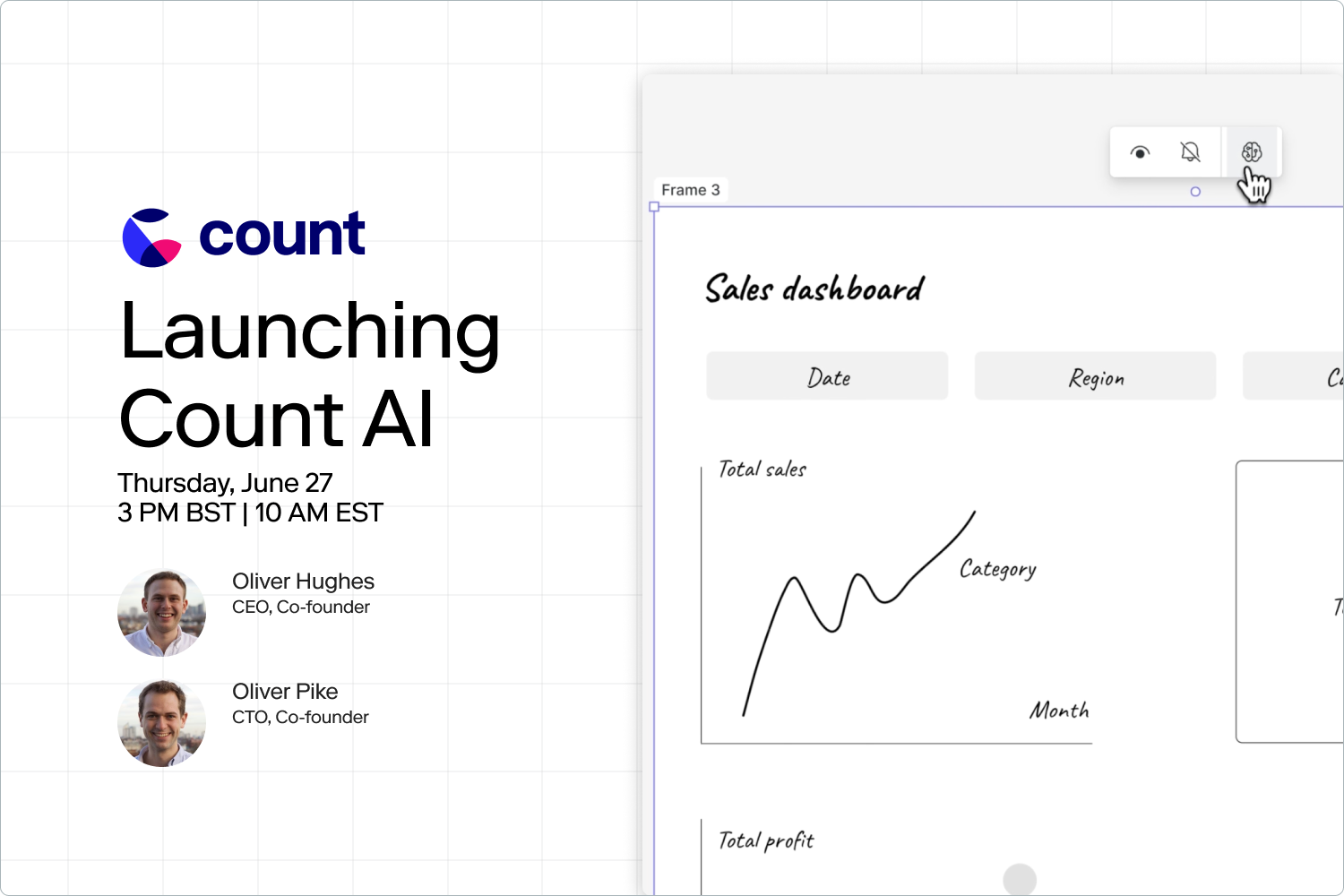
The Count Olivers are teaming up for our live AI launch event on the 27th of June. See the full range of Count AI, and the larger vision for AI in Count.
Reserve your spothere.