Count is a collaborative agentic analytics platform

Data
Product

Everything you need to make AI insights actionable, accurate, and actually useful

Get started

14-day trial or Free tier

Speeding up already fast-moving companies

2+ years
Read →
2+ years
5.0
2+ years
Read →
1+ years
Read →
2+ years
5.0
Left tableau
5.0
Left lightdash
Read →
1+ years
2+ years
5.0
Left tableau
1+ years
5.0
Left looker
5.0
2+ years
3+ years
5.0
The problem

BI rarely gives you the answer you need. Chatbots rarely give you the answer you can use

You're struck choosing between slow and safe (and too many dashboards) or fast and reckless (and not enough trust). We think that's just ridiculous.
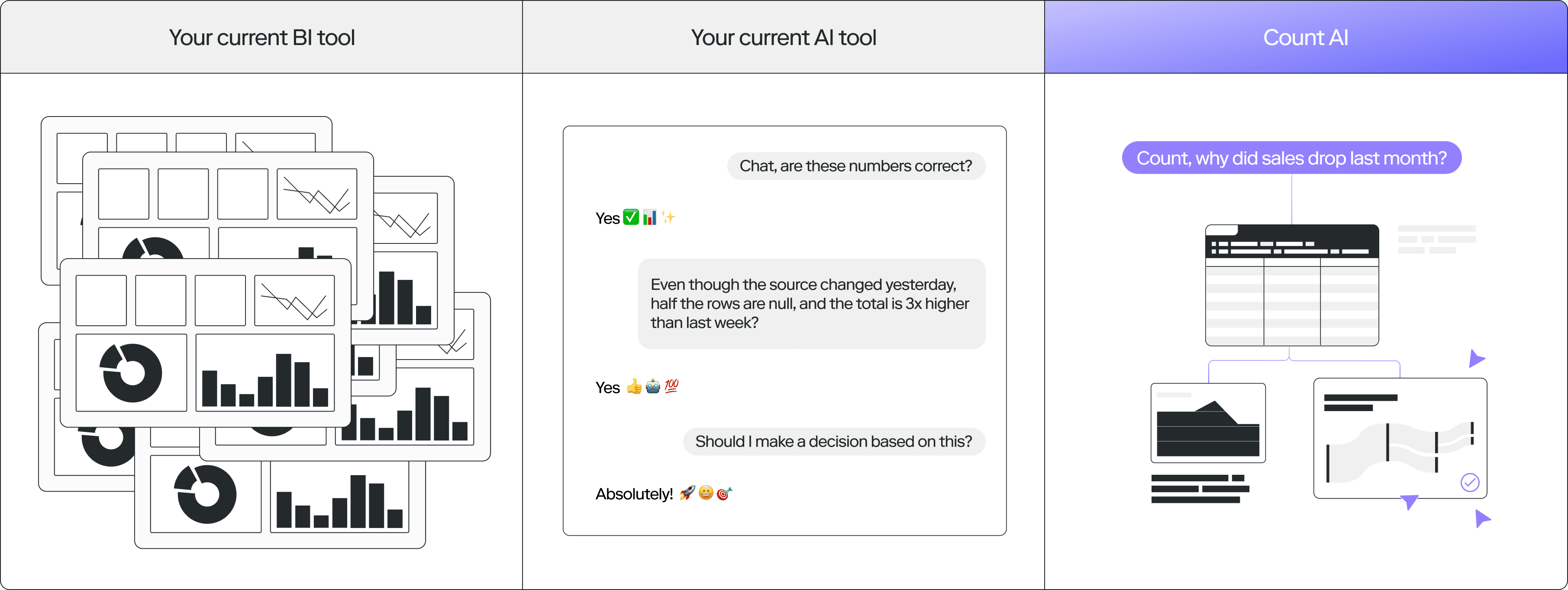
AI Comparison Table
The solution

AI Analytics your team can work with

Bringing the best of AI and BI together so teams can work with agents, not just query them, and move from exploration to trusted decisions without losing control.

The modern agentic analytics stack for the modern data stack

Count closes the gap between instant charts and actionable decisions bringing collaboration, compute, and context to every problem.
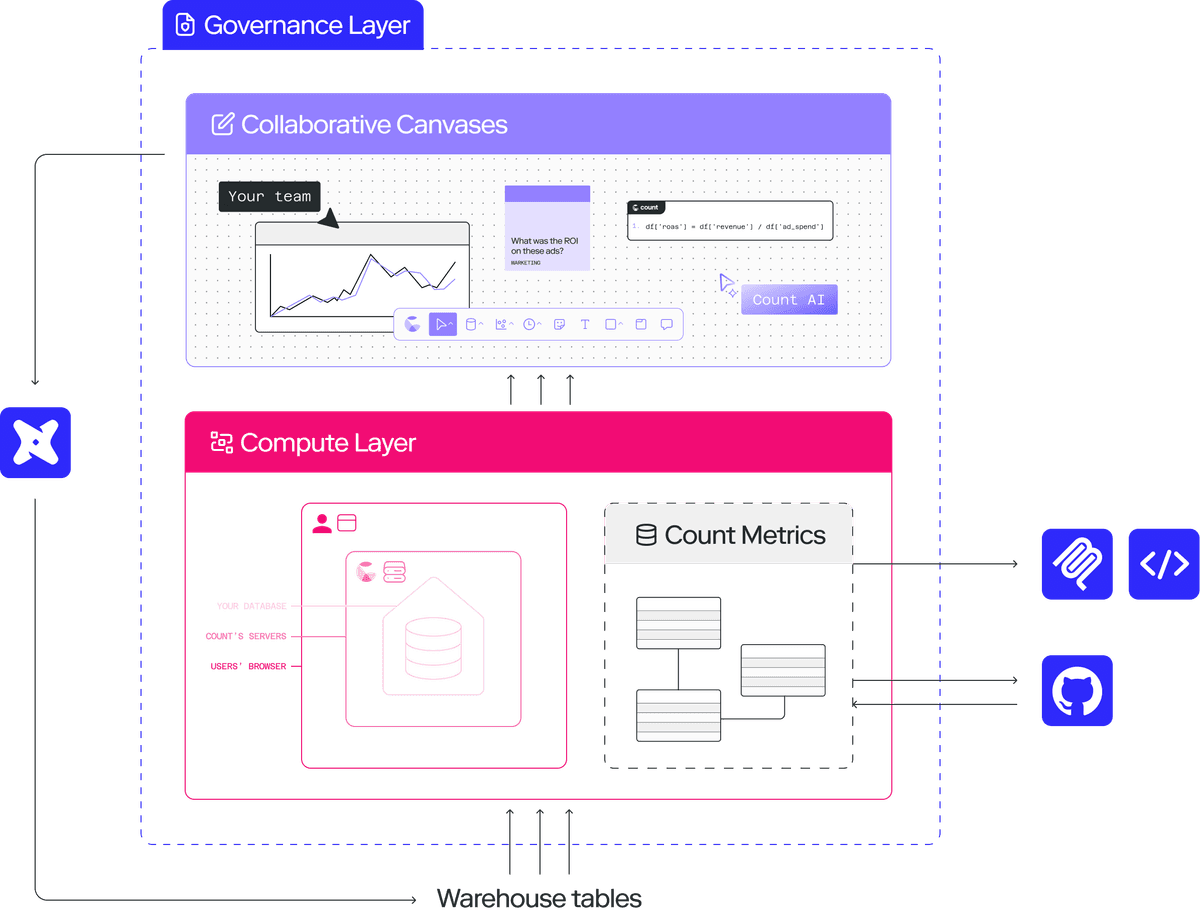
Product overview

Work alongside AI agents on a shared canvas. Combine the power of AI with human expertise to explore data, build analyses, and solve problems together in real-time.

Learn more →

Fast, cost-effective data access at scale. Our intelligent compute layer optimizes every query, leting agents write and process more queries faster than any human could without sacrificing accuracy or ballooning costs.

Learn more →

Enterprise-grade governance without the complexity. Define guardrails, context, permissions and access, all the while maintaining full visibility over how AI interacts with your data.

Learn more →

15 seconds, 100 queries, and accurate actionable insight. All in one canvas

See how quickly Count's agent can save you time

Self-service analytics you can trust

Build a context-rich governed catalog to support every team in accessing accurate insight

Find out why direct traffic is low this month in website_analytics and compare it to historical_traffic
Calculate CAC by channel from ad_spend_q4 and crm_signups and show me which campaigns are underperforming
Break down email open rates in email_campaigns by segment and benchmark against email_industry_benchmarks
Show me the customer journey from first touch to conversion using marketing_attribution and compare to saas_conversion_funnels
Compare social media engagement in social_metrics across platforms and benchmark against social_media_standards
Analyze landing page performance from google_analytics and compare conversion rates to industry_landing_pages
Find the best performing ad creatives in facebook_ads by ROAS and compare to ad_performance_benchmarks
Track MQL to SQL conversion rates in lead_data and compare to b2b_conversion_rates
Show me brand search trends in search_console versus competitors in semrush_market_data
Identify churn risk segments in customer_data using engagement scores from marketing_touches and churn_prediction_models
Find out why direct traffic is low this month in website_analytics and compare it to historical_traffic
Calculate CAC by channel from ad_spend_q4 and crm_signups and show me which campaigns are underperforming
Break down email open rates in email_campaigns by segment and benchmark against email_industry_benchmarks
Show me the customer journey from first touch to conversion using marketing_attribution and compare to saas_conversion_funnels
Compare social media engagement in social_metrics across platforms and benchmark against social_media_standards
Analyze landing page performance from google_analytics and compare conversion rates to industry_landing_pages
Find the best performing ad creatives in facebook_ads by ROAS and compare to ad_performance_benchmarks
Track MQL to SQL conversion rates in lead_data and compare to b2b_conversion_rates
Show me brand search trends in search_console versus competitors in semrush_market_data
Identify churn risk segments in customer_data using engagement scores from marketing_touches and churn_prediction_models
Show me feature adoption trends from user_events and compare to product_adoption_curves
Compare conversion rates between variants in ab_test_results and benchmark against experimentation_benchmarks
Find the most common user paths before checkout in clickstream and compare to ecommerce_best_practices
Analyze NPS scores from user_surveys by feature usage in product_analytics and benchmark against nps_industry_scores
Show me DAU/MAU ratios from engagement_metrics and compare to saas_engagement_benchmarks
Identify features with declining usage in feature_tracking and cross-reference with product_analytics_patterns
Calculate time-to-value for new users in onboarding_events and benchmark against onboarding_standards
Find correlation between app crashes in error_logs and user churn in retention_data using reliability_impact_studies
Show me funnel conversion rates from product_funnels and compare to conversion_benchmarks
Analyze mobile vs desktop usage patterns in platform_data and compare to device_usage_trends
Show me feature adoption trends from user_events and compare to product_adoption_curves
Compare conversion rates between variants in ab_test_results and benchmark against experimentation_benchmarks
Find the most common user paths before checkout in clickstream and compare to ecommerce_best_practices
Analyze NPS scores from user_surveys by feature usage in product_analytics and benchmark against nps_industry_scores
Show me DAU/MAU ratios from engagement_metrics and compare to saas_engagement_benchmarks
Identify features with declining usage in feature_tracking and cross-reference with product_analytics_patterns
Calculate time-to-value for new users in onboarding_events and benchmark against onboarding_standards
Find correlation between app crashes in error_logs and user churn in retention_data using reliability_impact_studies
Show me funnel conversion rates from product_funnels and compare to conversion_benchmarks
Analyze mobile vs desktop usage patterns in platform_data and compare to device_usage_trends
Explain the variance between budget and actuals in q3_expenses and benchmark against expense_ratios
Forecast next quarter's revenue using sales_pipeline and historical_close_rates with economic_indicators
Calculate burn rate from monthly_expenses and compare to startup_runway_benchmarks
Show me vendor spend in ap_data and compare pricing to vendor_market_rates
Analyze gross margin by product line from revenue_detail and benchmark against industry_margins
Find payment delays in ar_aging and compare DSO to payment_term_standards
Compare headcount costs in payroll_data versus compensation_benchmarks by role and location
Show me inventory turnover from warehouse_data and compare to inventory_management_standards
Calculate unit economics from cohort_revenue and cohort_costs and benchmark against ltv_cac_ratios
Analyze operational efficiency metrics in ops_dashboard and compare to operational_kpis
Explain the variance between budget and actuals in q3_expenses and benchmark against expense_ratios
Forecast next quarter's revenue using sales_pipeline and historical_close_rates with economic_indicators
Calculate burn rate from monthly_expenses and compare to startup_runway_benchmarks
Show me vendor spend in ap_data and compare pricing to vendor_market_rates
Analyze gross margin by product line from revenue_detail and benchmark against industry_margins
Find payment delays in ar_aging and compare DSO to payment_term_standards
Compare headcount costs in payroll_data versus compensation_benchmarks by role and location
Show me inventory turnover from warehouse_data and compare to inventory_management_standards
Calculate unit economics from cohort_revenue and cohort_costs and benchmark against ltv_cac_ratios
Analyze operational efficiency metrics in ops_dashboard and compare to operational_kpis
Check customer_database for duplicates and anomalies, then validate against data_quality_rules
Find correlations between product_usage and churn_data and compare patterns to churn_research
Clean and standardize addresses in customer_addresses using address_validation_api
Build a customer segmentation model from behavioral_data and compare to segmentation_frameworks
Detect outliers in transaction_data using methods from anomaly_detection_techniques
Enrich company data in leads_list with firmographic data from company_intelligence
Calculate statistical significance of trends in experiment_results using tests from statistical_methods
Map fields from legacy_export to schema in data_warehouse_spec
Profile dataset quality in production_tables and compare to standards in data_governance_policies
Join customer records from crm_data with demographic data from census_demographics
Check customer_database for duplicates and anomalies, then validate against data_quality_rules
Find correlations between product_usage and churn_data and compare patterns to churn_research
Clean and standardize addresses in customer_addresses using address_validation_api
Build a customer segmentation model from behavioral_data and compare to segmentation_frameworks
Detect outliers in transaction_data using methods from anomaly_detection_techniques
Enrich company data in leads_list with firmographic data from company_intelligence
Calculate statistical significance of trends in experiment_results using tests from statistical_methods
Map fields from legacy_export to schema in data_warehouse_spec
Profile dataset quality in production_tables and compare to standards in data_governance_policies
Join customer records from crm_data with demographic data from census_demographics
Create a board-ready summary of our key metrics from company_dashboard and benchmark against public_company_metrics
Show me quarterly revenue trends from financial_summary and compare to market_growth_rates
Analyze our market position using sales_data versus competitors in market_share_reports
Calculate customer lifetime value from customer_cohorts and compare to industry_ltv_benchmarks
Show me team productivity metrics from workforce_analytics benchmarked against productivity_standards
Compare our growth rate from monthly_metrics to venture_backed_companies in our stage
Analyze profitability by segment in p_and_l and compare margins to competitor_financials
Show me customer acquisition trends from growth_metrics versus market TAM in market_sizing_data
Calculate our NRR from revenue_retention and benchmark against saas_retention_rates
Build an investor deck summary from key_metrics with comparables from public_market_multiples
Create a board-ready summary of our key metrics from company_dashboard and benchmark against public_company_metrics
Show me quarterly revenue trends from financial_summary and compare to market_growth_rates
Analyze our market position using sales_data versus competitors in market_share_reports
Calculate customer lifetime value from customer_cohorts and compare to industry_ltv_benchmarks
Show me team productivity metrics from workforce_analytics benchmarked against productivity_standards
Compare our growth rate from monthly_metrics to venture_backed_companies in our stage
Analyze profitability by segment in p_and_l and compare margins to competitor_financials
Show me customer acquisition trends from growth_metrics versus market TAM in market_sizing_data
Calculate our NRR from revenue_retention and benchmark against saas_retention_rates
Build an investor deck summary from key_metrics with comparables from public_market_multiples
Get value in two minutes or don't pay us (free tier only)GRAB A CSV AND GET STARTED FOR FREE →

The best AI agent is just the beginning of the best BI tool

Ask your question and get a canvas. Share your canvas and get a decision. Monitor that decision and improve your business.

All your BI tool pain made pleasure

That little ding sound

Send alerts, reports and entire canvases to Slack and email
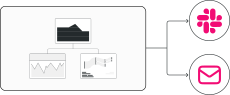
Send alerts, reports and entire canvases to Slack and email
Count Metrics

Our semantic layer for governed, performant metrics, and drag-and-drop analysis

Our semantic layer for governed, performant metrics, and drag-and-drop analysis
Ask before you touch

Fine-grain or group-wide permissions

Fine-grain or group-wide permissions
Use more pay less

Query, canvas, and semantic layer caching
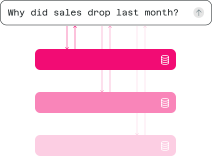
Query, canvas, and semantic layer caching
Fine

You can make gridded-dashboards if you really want
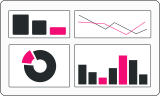
You can make gridded-dashboards if you really want

Count runs alongside your current BI tool. Until it runs ahead

When you rethink AI, replacing your BI tool doesn't seem so crazy
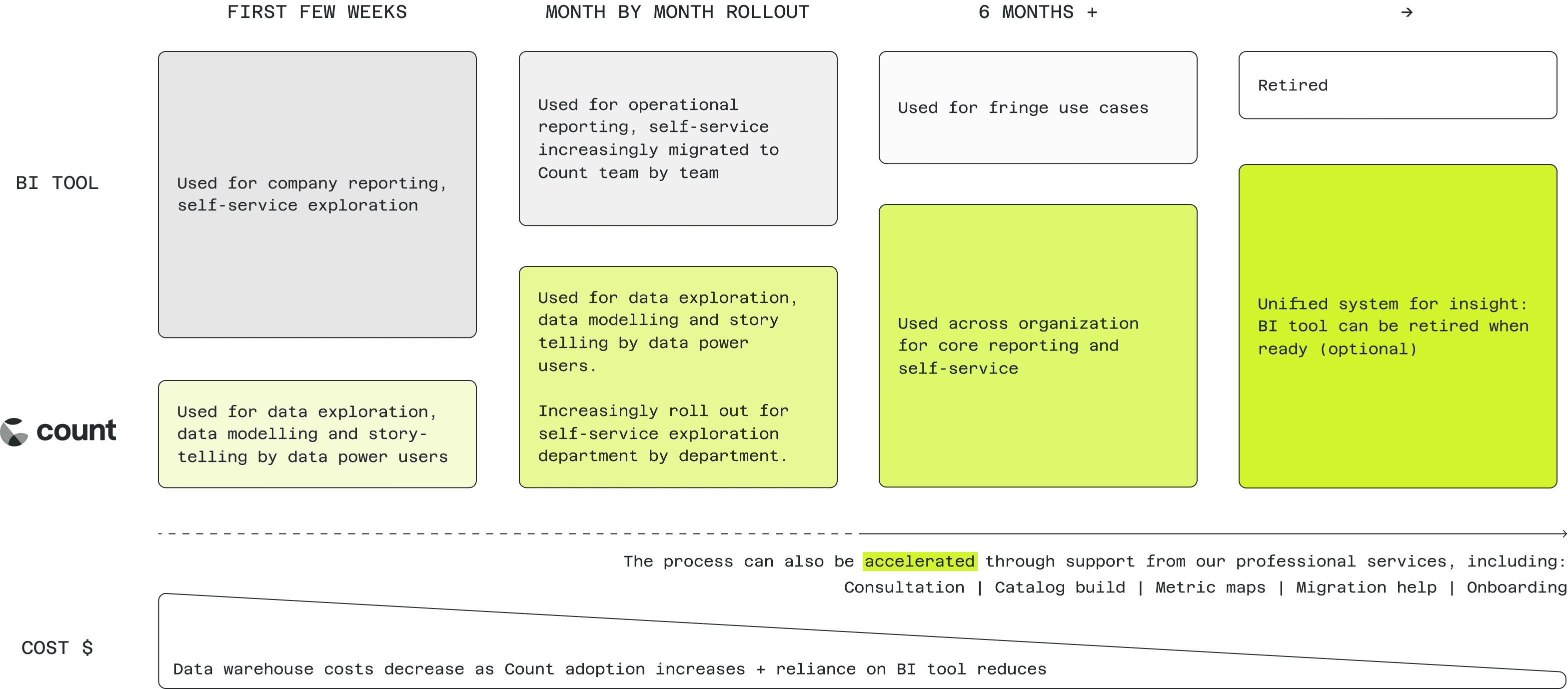
Migration plan

FAQs

Your data is not used for training external AI models. Data is only sent when the user interacts with the AI agent in the visible chat interface. No scheduled or background processing with AI occurs without user action.

We're strong believers that making data more accessible with more clarity for more people underpins the improvement cycle. This hasd driven the way we have built Count's canvas, reporting, analysis, and monitoring functionality. You might know it by other names, agile if you are in product, DMAIC if you did Six Sigma etc., but fundamentally business problems are best solved when they are identified proactively, when they explored using data, when teams can collaborate and make informed decisions faster, and when effective organizational monitoring is put in place, rather than quickly just forgotten dashboards.

Count is used by countless customers to solve exactly these challenges in ways that traditional data analysis tools can't.

All queries and lineage are visible. You can click on any visualization to see underlying calculations and SQL. Everything the AI creates are standard Count objects that can be edited and verified.

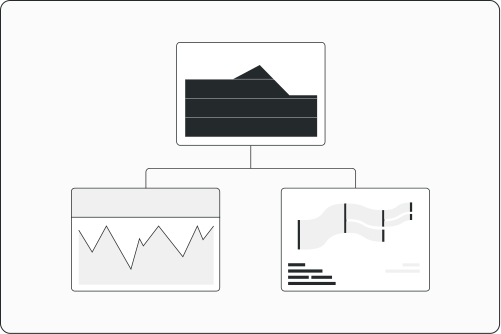
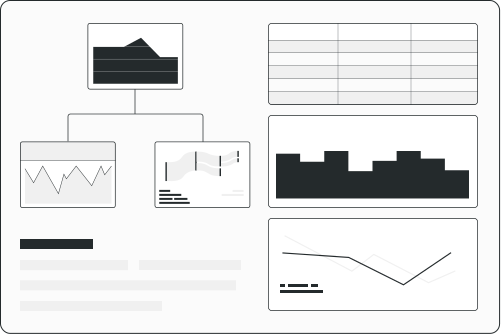
You can still make traditional grid-dashboards using Count, we just think they aren't always or even often the best way to solve business problems. At it's heart, Count is a powerful tool for widening and deepening the organization's awareness of its data, and the real world events it represents and influences. The canvas lets you break out of the dashboard or report format to show the relationships between metrics, and between metrics and business/product processes. For example, you can create a metric tree to make financial models clearer, or put usage data next to screenshots of your app to help the entire business understand usage.

Yes. You can sign up for 14-days and get started today. No sales calls, no nonsense. We'd love to help you develop a proof of concept internally to help make the case for change, but you can connect a database today and get building and sharing canvases.

You can also sign up for a completely—but more limited—free account and then contact us asking for a trial at a later date, or upgrade to a paid account.

Yes. You can connect your data sources in just a few clicks. We support Athena, Azure Synapse, BigQuery, Databricks, MySQL, PostgreSQL, Redshift, Snowflake, and SQL Server. Enterprise plans can also integrate with a range of Single Sign On providers (Okta, Entra ID, JumpCloud Google Generic OIDC).

Yes. While many customers quickly migrate fully from their legacy BI tool, Count also plays nicely with existing data infrastructure like dbt letting you easily run it alongside. Count is a great way of introducing BI and reporting to teams currently not well served by BI, or needing flexibility that just isn't possible in Looker, Tableau, Thoughtspot etc.


AnalyticsPlatforms BestEstimatedROI Mid-Market RoiAnalyticsPlatforms BestRelationship TotalAnalyticsPlatforms BestResults TotalAnalyticsPlatforms HighPerformer UnitedKingdom HighPerformerAnalyticsPlatforms Leader EMEA LeaderAnalyticsPlatforms MostImplementable Mid-Market Total
Ready to get started?

See how Count can transform your data workflow.

Get started for free